Why Product Leaders Bet on Ruby on Rails for Long-Term Growth
Discover why product leaders rely on Ruby on Rails for a strong balance of speed, scalability, security, and long-term stability that modern products demand.


Pichandal
Technical Content Writer


Great product leaders don’t bet on technologies, they bet on outcomes.
Ruby on Rails’ combination of rapid development, strong conventions, a massive ecosystem, proven real-world scalability, and predictable maintenance make it ideal for products that must learn quickly today and endure for the long run.
It, in turn, makes RoR one of the soundest technology choices for product organizations that want to move fast early, scale sensibly, and maintain long-term architectural health.
And when you look at the companies that have built category-defining businesses on Rails such as Shopify, GitHub, Basecamp, Instacart, Twitch, Airbnb (early), and many others, the message is clear.
Rails remains a high-confidence bet for growth-minded product teams.
After nearly two decades of engineering leadership and software development experience at RailsFactory, we’ve seen one pattern repeat across hundreds of teams. Product leaders don’t choose Rails because it’s trendy, they choose it because it consistently drives long-term product outcomes.
This is the story of why.
The Race to Market: Why Speed Still Wins
In product leadership, speed isn’t just a metric but a matter of survival. Whether validating a feature or launching a new product line, teams that learn faster win faster. Rails thrives here for one reason - it removes friction from every development step.
The framework’s “convention over configuration” philosophy eliminates hundreds of tiny decisions developers would otherwise have to make. The advantages of using Ruby on Rails have become even clearer as teams now can ship MVPs in weeks, not months (something we recently demonstrated with a client project). Features go live without rewiring half the codebase. Product leaders can test assumptions with real users instead of relying on internal guesswork.
It’s no surprise that founders and product heads at high-growth companies from Basecamp to Airbnb used Rails to iterate faster than their competitors. Speed to market is the first advantage. The compounding effect of continuous fast iteration is the next benefit that follows.
As we move closer to 2026, when customer expectations shift monthly, the ability to move fast without adding chaos becomes the defining edge.
Developer Productivity That Stays High as You Scale
A framework can make a team productive at small scale. The real test is what happens when:
-
your team grows from 3 to 30 developers,
-
features span multiple domains,
-
or half your team changes over three years.
Rails is one of the few ecosystems where productivity doesn’t degrade with size. Rails conventions are extremely clear. Patterns are predictable. New developers onboard in days, not weeks. Codebases remain readable even years later because Rails encourages simplicity and consistency.
You write less code to achieve more, without the architectural complexities that plagues many modern JS-heavy stacks.
This matters for product leaders measuring velocity, maintenance load, and development capacity. When your developers aren’t fighting the framework, they can focus entirely on product value.
A Framework With a Proven Billion-Dollar Track Record
Rails’ longevity isn’t nostalgia, it’s evidence.
The list of companies succeeding with Ruby on Rails is no longer a startup hall of fame; it’s a list of global giants:
-
Shopify processes billions in GMV annually.
-
GitHub powers the modern software ecosystem.
-
Airbnb and Instacart scaled across markets and devices.
-
Basecamp continues to ship world-class products decade after decade.
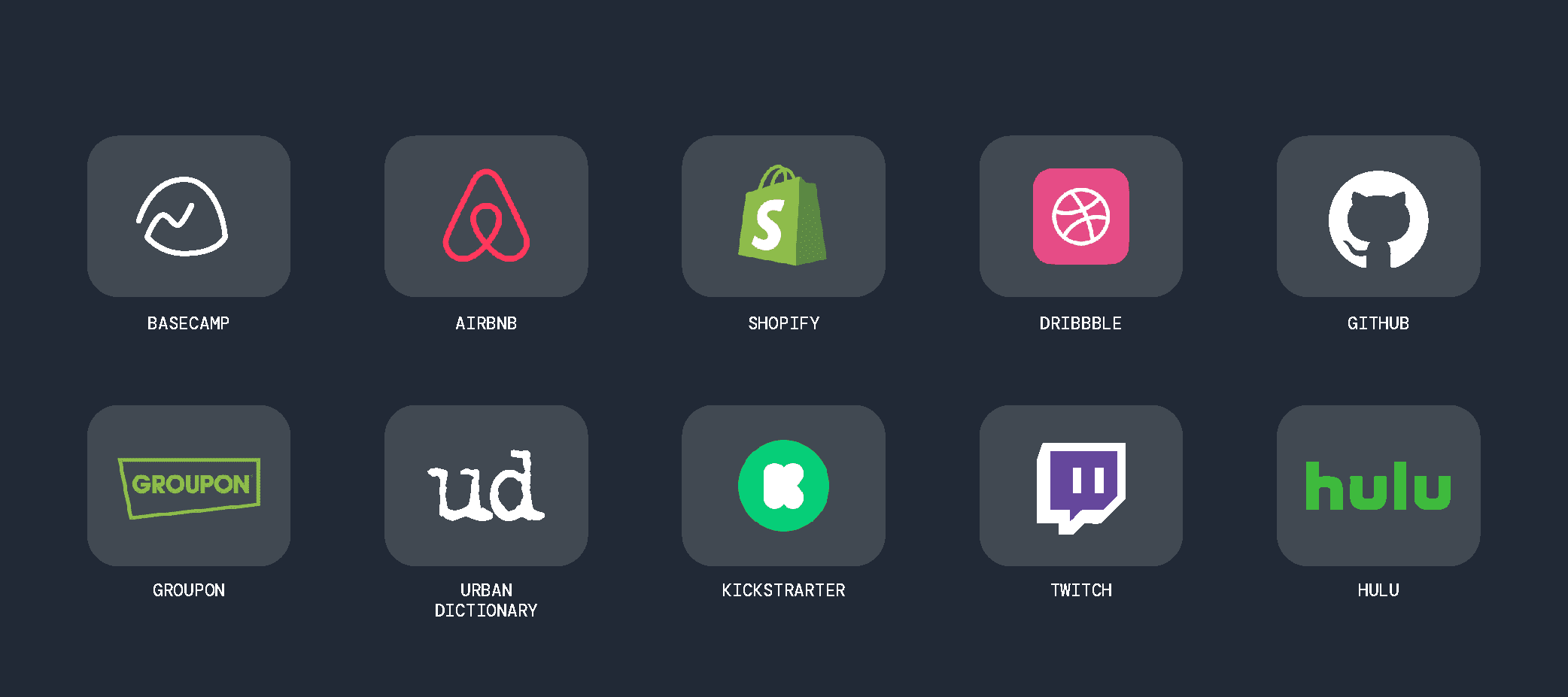
These teams didn’t just start on Rails, they built empires with it.
What this proves to product leaders is simple: Ruby on Rails is still a smart choice, and it scales easily when engineered correctly.
Scalability is not just about technology. It’s about organizational clarity, architectural discipline, and reducing complexity. Rails encourages all three.
Big systems don’t collapse because Rails can’t scale. They collapse because their teams scale without alignment. Rails’ conventions give teams a shared structure that growing teams often lack.
A Mature Ecosystem That Eliminates Reinvention
Most product teams don’t have the luxury of reinventing solved problems.
Things like authentication, payments, background jobs, email delivery, dashboards, reporting, and file storage are essential, yet they don’t set your product apart. Rails’ ecosystem provides thousands of high-quality gems that are:
- well maintained,
- secure,
- battle-tested in production,
- and standardized across the industry.
This means your team isn’t wasting months building infrastructure that has already been solved elegantly and efficiently.
Instead, they spend time where it actually matters by building product value and creating the features that differentiate you in your market.
This is one of the biggest reasons why Rails teams consistently deliver more with smaller engineering squads.
Built-In Security That Reduces Risk from Day One
Security is rarely spotlight feature, but it’s always critical especially at enterprise scale.
Rails includes robust security defaults out of the box:
-
CSRF protection
-
XSS safeguards
-
SQL injection prevention
-
Secure session handling
-
Strong parameter policies
Product leaders enjoy a “security-first by default” posture without investing heavy upfront effort.
Compliance teams appreciate Rails for exactly this reason. When your foundation is designed to avoid the most common vulnerabilities, the cost of maintaining a secure environment becomes dramatically lower.
Monolith-First Architecture: The Most Underestimated Advantage
In recent years, monolithic architectures have made a comeback, not as a trend, but as a realization that over-engineering too early kills productivity.
Rails has always championed a monolith-first approach. For product teams, this is a superpower:
-
Fewer moving parts
-
Lower DevOps overhead
-
Faster debugging
-
Simpler deployments
-
Easier team communication
If and when certain features need independent scaling (background workers, search services, analytics pipelines), you can extract them strategically, not prematurely.
Most startups never need to fully transition to microservices. Rails helps you scale sensibly, without locking you into complexity before you’re ready.
The Predictability CFOs, CTOs & Product Leaders Love
One of the biggest hidden costs in modern tech stacks is architectural volatility.
Frameworks evolve quickly. Tooling changes annually. Paradigms shift from SPAs to SSR to islands architecture to lightweight servers to serverless to… whatever comes next.
Rails is different.
It evolves steadily, with a clear, predictable upgrade path. Core principles remain intact. The ecosystem doesn’t fragment every two years.
This gives product leaders a rare advantage by providing long-term predictability for maintenance budgets, hiring plans, and technical strategy.
Rails apps age gracefully. Technical debt accrues slower. Teams spend less time on rewriting systems and more time building features.
For companies betting on long-term growth, this stability is invaluable.
Hiring Becomes Easier and Scaling Teams Becomes Smoother
Hiring is one of the most expensive and time-consuming parts of scaling a product organization.
Rails offers three key hiring advantages:
-
A large, global talent pool - Since experienced Rails talents are widely available, hiring Ruby on Rails developers is rarely a bottleneck.
-
Strong community patterns - Rails projects follow consistent conventions, which means new developers onboard faster because most Rails apps feel structured in a familiar way.
-
Lower team size requirements - productivity is high, so you need Rails development team with only fewer engineers to maintain velocity.
This is why so many product leaders prefer Rails: You can do the same amount of work with leaner teams and get better consistency.
And yes, this also makes Rails an excellent fit for offshore or hybrid-model teams because conventions act as a shared language.
Lower Total Cost of Ownership (TCO) Over the Product Lifecycle
When we work with enterprise clients at RailsFactory, this is the insight that usually surprises them most:
Rails reduces cost not by being “cheap,” but by being efficient.
Fewer developers. Less rewriting. More reuse. Stable upgrades. A predictable architecture. An ecosystem that avoids duplication. A monolith that avoids premature complexity.
When you add it all up, Rails delivers one of the lowest long-term cost curves in the industry. This is also one of the key reasons why product leaders choose Rails for the long run.
Final Thoughts: Why Rails Wins in the Long Run
Rails offers something incredibly rare. A stable, productive, secure, and scalable foundation that compounds value over time.
Fast MVPs become stable V1s (first versions). Stable V1s become scalable platforms. Platforms become product ecosystems.
Rails has powered this journey for some of the most successful companies in the world, and it continues to do so because the fundamentals haven’t changed:
-
speed still wins,
-
clarity still scales,
-
secure defaults still matter,
-
monoliths are still the smartest way to start,
-
and productivity is still the most important metric of all.
For product leaders, the question isn’t “Why Rails?” It’s “Why bet your long-term growth on anything less proven?”
And as a team that has spent 19+ years in the Ruby on Rails world, we’ve seen firsthand how companies accelerate their roadmaps, reduce cost, and scale efficiently when they choose Rails with the right architectural discipline.
If you're gearing up to build a new product, navigating a Rails upgrade, or you're midway through your development journey and need expert guidance, contact our team at RailsFactory. We’re here to support you every step of the way.